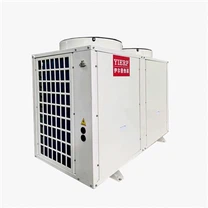
The air source heat pump system mainly consists of a compressor, condenser, evaporator, throttling device, as well as connecting pipes and other auxiliary refrigeration components. The system is charged with refrigerant (also called refrigerating fluid or coolant), which is driven by the compressor to circulate through the system, completing the four processes of compression, condensation, throttling, and evaporation.
Core Component Functions
Condenser
A heat exchange device through which the system releases heat to a high-temperature heat source. The high-temperature refrigerant gas condenses into liquid here, releasing heat (condensation heat release). Common types include finned tube heat exchangers, shell-and-tube heat exchangers, plate heat exchangers, and jacketed heat exchangers.
Evaporator
A heat exchange device through which the system absorbs heat from a low-temperature heat source. The low-temperature refrigerant liquid evaporates into gas here, absorbing heat (evaporation heat absorption). Common types include finned tube heat exchangers and shell-and-tube heat exchangers.
Expansion Device
An important component of the heat pump system, primarily used to throttle and reduce the pressure of the high-pressure refrigerant liquid, ensuring the pressure difference between the evaporator and condenser; at the same time, it regulates the refrigerant flow entering the evaporator, allowing the system to operate efficiently. Common types include capillary tubes, electronic expansion valves, and thermostatic expansion valves.
Compressor: It is the power source that drives the circulation of refrigerant in an air source heat pump system, equivalent to the 'heart' of the system. It compresses the low-temperature, low-pressure refrigerant gas absorbed from the evaporator into high-temperature, high-pressure refrigerant gas and sends it to the condenser. Common compressors include scroll rotor heat pump compressors and scroll heat pump compressors, among others.
Compressor
It is the power source that drives the circulation of refrigerant in an air source heat pump system, equivalent to the 'heart' of the system. It compresses the low-temperature, low-pressure refrigerant gas absorbed from the evaporator into high-temperature, high-pressure refrigerant gas and sends it to the condenser. Common compressors include scroll rotor heat pump compressors and scroll heat pump compressors, among others.

Special design requirements for air source heat pumps
Due to a working temperature range different from conventional compression heat pumps such as water source and ground source heat pumps, air source heat pump units need to be equipped with some auxiliary components, and special requirements are proposed for the heat pump compressor, condenser, and evaporator:
Four-way reversing valve
Because it operates in cooling mode in summer and heating mode in winter, and cannot switch through a water system valve like a water source heat pump, a four-way reversing valve needs to be installed to achieve the conversion between heating and cooling modes.

Gas-Liquid Separator
During defrosting under heating conditions, the condenser will convert into an evaporator, and excessive liquid refrigerant may be drawn into the compressor causing 'liquid hammer' damage. Therefore, a gas-liquid separator is installed on the suction line.
Air/Refrigerant Heat Exchanger
Since the evaporator and condenser switch functions in different modes, and their design requirements, performance characteristics, and load capacities differ, it is necessary for the air/refrigerant heat exchanger (or water/refrigerant heat exchanger) to meet the working conditions for both winter and summer.
Dedicated compressor: In heating mode, the outdoor air temperature varies widely (approximately -25 to 15°C), resulting in a high compression ratio and high discharge temperature for the compressor. Therefore, a dedicated compressor that meets heat pump operating conditions should be selected, rather than a conventional refrigeration compressor.
High-pressure receiver
Because the refrigerant mass flow differs between winter and summer seasons, a high-pressure receiver is needed to store excess refrigerant.
Compatible throttling device
The difference between the condenser pressure and evaporator pressure differs significantly in heating and cooling modes, and the direction of refrigerant flow is opposite. Therefore, a throttling device that meets the operating requirements should be selected and installed.