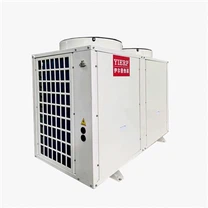
How many types of heat pumps are there?
According to different heat sources, heat pumps can be divided into air source heat pumps, water source heat pumps, and ground source heat pumps.
Image
Is a heat pump water heater a solar product?
Broadly speaking, yes, but the heat pump unit is fundamentally different from conventional solar products, mainly reflected in the differences in working principles: conventional solar products rely on direct sunlight or radiation to achieve heating, whereas the heat pump unit primarily absorbs heat from the environment to achieve heating.
On what principle does a heat pump unit absorb heat?
The heat pump unit is equipped with a specially designated heat-absorbing medium-refrigerant. In its liquefied state, it is below -20°C and has a temperature difference with the outside environment. Therefore, the refrigerant can absorb external heat energy, evaporate and vaporize inside the evaporator, increase the temperature of the refrigerant through the work of the compressor in the heat pump unit, and then convert the refrigerant from a vaporized state to a liquefied state through the condenser. During this conversion process, a large amount of heat is released and transferred to the water stored in the tank, raising the water temperature to achieve the purpose of heating water. This is one of the features of this product and also a reason for its market potential.
What are the advantages of heat pump units compared to other heating methods?
The main advantages of heat pump unit heating are: high efficiency, green and energy-saving, and reliable. There are no combustible or explosive gases, no electrically driven components, making it completely reliable; there are no emissions of exhaust gas, wastewater, or residue, making it entirely green and energy-saving. The annual average operating cost of a heat pump unit is only one-quarter of direct electric heating, one-third to one-half of oil or gas heating, and two-thirds of conventional solar energy heating.
How much electricity does an air source heat pump unit generally consume?
The thermal efficiency of an air source heat pump unit is generally 300%-500%. With a temperature rise of 40°C, producing one ton of hot water consumes about 9-15 kWh of electricity. In contrast, ordinary electric heating methods require 52 kWh.
Image
Is the air source heat pump unit easy to use and operate?
It is very simple to use. The entire unit is equipped with an automated intelligent control system. The user only needs to turn on the power during the first use. In future use, it operates fully automatically. It automatically stops when the user-specified water temperature is reached, and automatically starts running when the temperature falls below the specified level. This allows hot water to be available 24 hours a day without waiting.
Can the heat pump unit operate normally in low winter temperatures?
Air source heat pump units have an intelligent defrost function to ensure stable operation in l ow-temperature environments. They can automatically enter and exit defrost based on a comprehensive and intelligent judgment of multiple parameters such as outdoor temperature, evaporator fin temperature, and unit operating time.
Image
Compared with conventional solar energy, what advantages do air source heat pump units have?
The advantages are very obvious, mainly in four aspects:
1. Investment aspect: To achieve the same water supply effect, the investment in a heat pump water heater is less than in conventional solar products. It can also use economical electricity to heat water during off-peak hours.
2. Usage aspect: Conventional solar products are significantly affected by weather-on cloudy, rainy, snowy days, or at night, they cannot operate. In contrast, heat pump water heaters can work normally regardless of cloudy, rainy, snowy days, night, or sunny weather, providing hot water all day.
3. Operating cost aspect: Conventional solar devices operate at almost zero cost under direct sunlight, but on cloudy, rainy, snowy days or at night, they rely on auxiliary systems. Statistics show that with normal use, the annual electricity consumption of conventional solar auxiliary systems is higher than the total annual electricity consumption of heat pump units.
4. Other functionalities: Heat pump units are not restricted by location and can be placed anywhere, occupying very little space. To achieve the same heating effect, conventional solar systems take up a large area and must be placed outdoors. Heat pump units can produce cool air while heating water, which can be used for dehumidification, cooling, and air purification auxiliary functions.