
Final Solution
Real-time precise dew point calculation
The indoor thermostat is equipped with a high-precision temperature and humidity sensor that collects indoor air temperature and relative humidity data in milliseconds. This data is synced in real-time to the main control unit via 485 wireless communication. The main control calculates the current indoor dew point temperature in real-time using the saturated vapor pressure formula and, combined with the floor radiation heat transfer coefficient, estimates a safe water supply temperature threshold.
Responds to water temperature changes in seconds
When the dew point temperature changes and the supply water temperature needs to be adjusted, the main unit doesn't mix hot and cold water through a valve. Instead, it directly adjusts the operation of the refrigerant system: it changes the speed of the variable frequency compressor and the opening of the electronic expansion valve, precisely altering the refrigerant evaporation temperature in the evaporator, which directly changes the water temperature.
Balancing anti-condensation and energy saving
Many anti-condensation systems set the water supply temperature higher than necessary to be absolutely safe, which ends up reducing cooling efficiency and the overall experience. Yierp's automatic dew point tracking algorithm uses a dynamic safety margin strategy to boost anti-condensation reliability.
In the Yierp four-pipe control system, the two water circuits each have their own role:
- The dehumidification circuit can output low-temperature water as needed, fully handling indoor moisture loads, keeping indoor relative humidity stable between 40%-60%, directly lowering the dew point temperature, and reducing the risk of condensation right at the source.
- The radiant circuit stays in a high-temperature range, focusing on sensible heat loads, working with dynamic dew point tracking to ensure the floor doesn't get condensation.
Temperature and humidity are controlled separately without interfering with each other, which not only ensures effective dehumidification but also keeps condensation at bay. At the same time, it avoids the traditional problems of "cooling always too cold, dehumidifying always too dry," achieving a comfortable experience with constant temperature and humidity without the dryness.
product key technologies
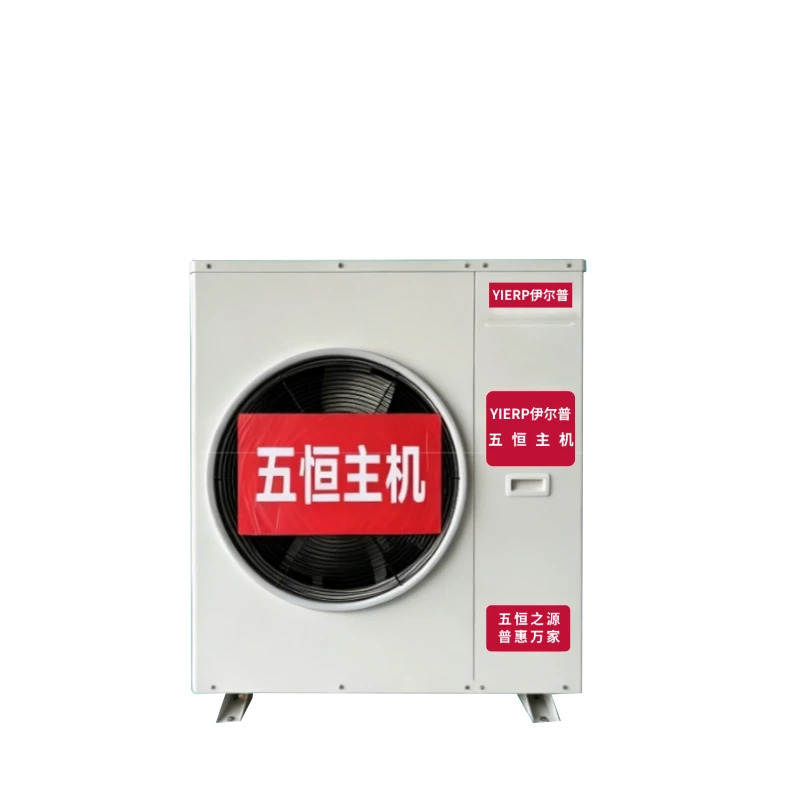
Two independent water temperature outputs
The Yierp Five-Constant air conditioner achieves a hardware foundation for no mixed water, thanks to its patented four-pipe, dual-water path design. Unlike traditional dual-supply systems with a single heat exchanger and one water output, it has two completely independent plate heat exchangers with two separate water circulation loops. This allows it to simultaneously provide two different temperatures of chilled water, with the water paths completely independent and controlled separately.
Automatic dew point tracking algorithm
The four-pipe system solves the problem of 'being able to produce high-temperature water,' but the real key to precise anti-condensation is the automatic dew point tracking and dynamic temperature adjustment technology. Its control logic is totally different from the mixing module: mixing adjusts the water proportion on the water side through valves, while dew point tracking adjusts the evaporation temperature on the refrigerant side directly via the compressor and electronic expansion valve, which in turn changes the water temperature.
Preventing condensation doesn't rely solely on adjusting the water temperature. It's a tiered strategy: 'Dehumidify first → Adjust water temperature → Shift load → Alarm protection':
Prioritize fresh air dehumidification. When room humidity starts to rise, the system first links the fresh air dehumidification unit to boost dehumidification capacity, reducing indoor absolute humidity and directly lowering the dew point temperature. This way, the water temperature for radiant cooling isn't raised unnecessarily, maintaining the effect of radiant cooling.
Logic: Lower humidity first; raise water temperature only if necessary, keeping as much radiant cooling capacity as possible.
Automatic radiant water supply adjustment following the dew point. If dehumidification alone can't suppress the dew point, the system gradually raises the supply water temperature in the radiant circuit, ensuring that the panels stay above the safe dew point. Radiant cooling output drops at this stage, so the system automatically increases convective cooling via fan coil units to compensate, keeping indoor temperature stable.
Risk warning & tiered protection
- Approaching risk threshold: The main unit and app will pop up a warning: 'Room humidity is too high, please close doors and windows.'
- Extreme conditions (prolonged open windows bringing in large amounts of humid air, outdoor humidity over 95% during plum rain season, and dehumidification still maxed out but unable to suppress dew point): The system will shut down the radiant circuit for that room, switching entirely to fan coil cooling. This physically eliminates condensation risk without shutting down the system, so the room can still stay comfortably cooled and ceiling water condensation is avoided.


