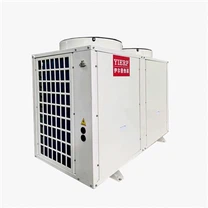
The whole system is divided into a main loop and an EVI booster loop, working together with dedicated components.
The process is as follows:
1. Main loop (main heating circuit) – high-pressure liquid refrigerant flows out of the condenser, and the main path's electronic expansion valve reduces pressure, then the refrigerant absorbs heat from the air through the evaporator, turning into low-temperature gas.4. Diversion and gas supplementation preparation
Some high-pressure liquid refrigerants undergo secondary throttling. The liquefied refrigerant cools down and further turns into stable medium-pressure saturated gas refrigerant, and this part of the gas is the EVI gas supplementation source.
Mid-stage injection enthalpy boost
The middle part of the compressor mixes with some mixed refrigerants, which can lower the temperature inside the chamber, increase the overall refrigerant mass flow, and raise the working fluid enthalpy.
Secondary compression and heat release
Secondary compression turns the mixed refrigerant into high-temperature, high-pressure gas refrigerant, which is sent to the indoor condenser to release heat for heating and hot water; after releasing heat, it turns back into liquid refrigerant and the cycle repeats.
The Difference Between Two Main Heat Exchange Structures
According to the different types of heat exchange components, the industry has two major technical solutions, with clear differences in application scenarios and performance:
• Flash Evaporator Solution: Simple structure, low cost, and low failure rate. It relies on throttling for direct gas-liquid separation to achieve gas replenishment, which is a common entry-level solution for EVI units, mostly used in conventional low-temperature areas in the north (within -25°C).
• Economizer (Plate Heat Exchanger) Solution: A high-end mainstream configuration. It uses a plate heat exchanger to achieve subcooling of the main loop refrigerant and vaporization of branch refrigerant, offering higher heat exchange efficiency, more precise refrigerant distribution, stronger low-temperature performance, and can adapt to extremely cold environments ranging from -30°C to -41°C. It's widely used in commercial heat pumps, industrial heat pumps, and high-end residential ultra-low temperature units.